
Why Am I So Irritable in Perimenopause?
Understanding Your Shorter Fuse
You used to be the person who could cope with almost anything.
Now the dishwasher is too loud, someone chewing beside you is driving you mad, and a perfectly reasonable question from someone you love can make you want to bite their head off.
Or perhaps it is not anger at all. You just feel as though you have less room for everything. Noise, interruptions, people wanting things from you, another job added to the list, things you once brushed off suddenly feel like too much.
And then comes the guilt “Why am I reacting like this?”
A shorter fuse can be one of the more surprising changes of perimenopause. Women will often tell me, “This just isn't me.”
But rather than blaming yourself for being irritable, it can be much more useful to ask what has changed?
Hormones don't only affect your periods
During perimenopause, oestrogen and progesterone don't simply drift gently downwards until menopause.
They can rise and fall quite dramatically, and those changes can affect much more than your menstrual cycle. Oestrogen and progesterone also influence the chemical messengers your brain uses to help regulate mood, motivation, attention and your response to stress.
What is actually happening in your brain?
Oestrogen affects neurotransmitters such as serotonin, dopamine and noradrenaline. These help with things like emotional steadiness, motivation, focus and resilience.
Progesterone has a calming role too. One of its breakdown products, allopregnanolone, acts on GABA receptors in the brain. GABA is one of the main chemical messengers involved in helping the nervous system settle.
So when oestrogen and progesterone are fluctuating, the signals your brain is receiving can fluctuate too. That may help explain why you can feel completely fine one week and much more irritable, anxious, overwhelmed or unable to cope with noise and stress the next.
And this is an important point: during perimenopause it is not always simply about hormones being low. Sometimes it is the ups and downs themselves that make things feel so unsettled.
That doesn't mean hormones are responsible for every bad mood. But they may change how much reserve you have available to deal with everything else.
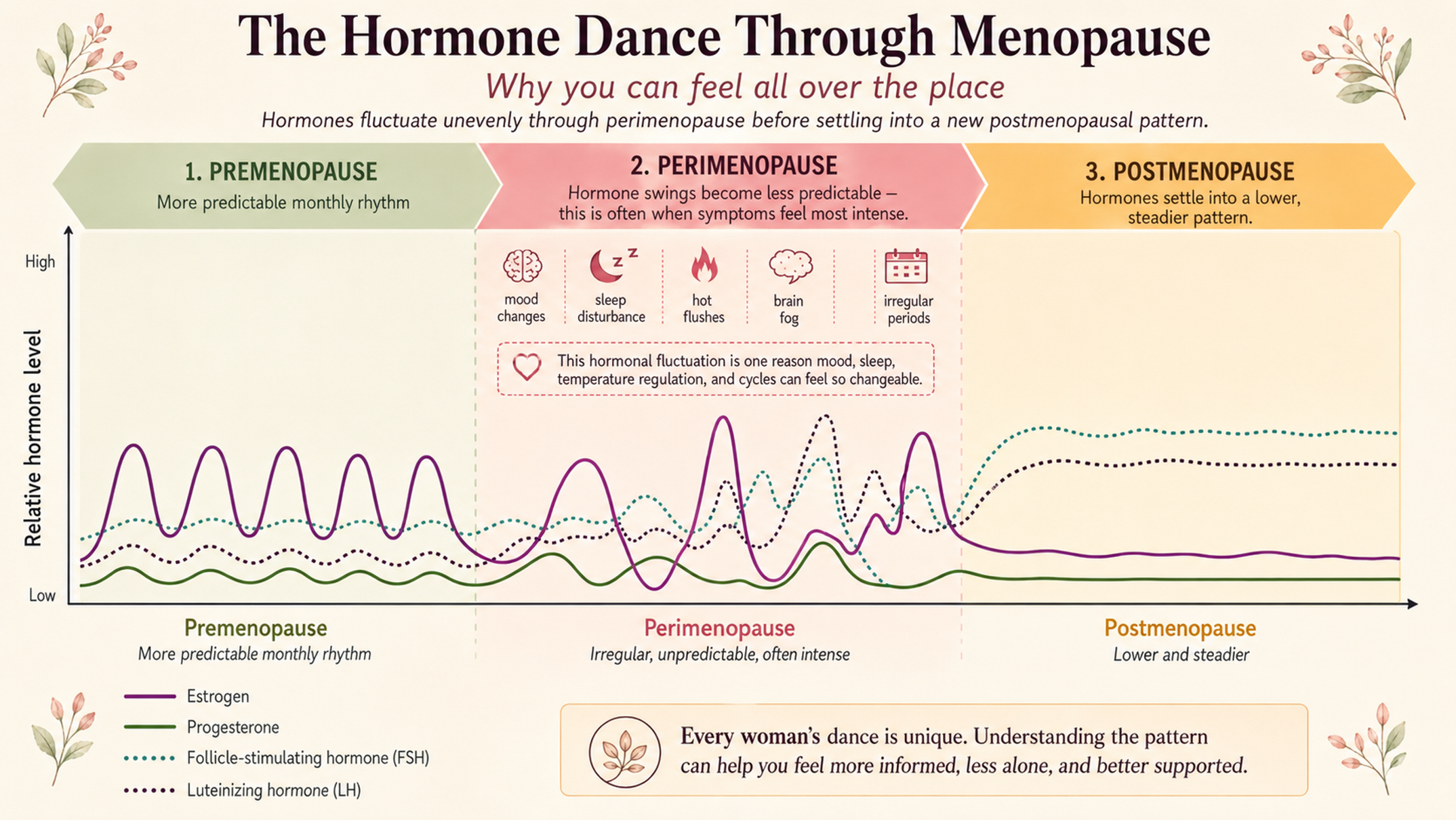
During perimenopause, hormone levels can fluctuate considerably rather than falling in a smooth, steady line. These changing levels can affect the brain, sleep, mood and stress response.
And then there's sleep...
This is a big one.
You might be waking hot, throwing the covers off, pulling them back on, waking at 3am with your brain suddenly deciding it is an excellent time to think about everything you've ever done - or simply sleeping more lightly than you used to.
Even if you are technically spending enough hours in bed, the quality of that sleep matters. A tired brain has less capacity for emotional regulation. Things that would normally be mildly annoying can suddenly feel enormous.
So before we decide your irritability is simply hormonal, I would want to know how are you actually sleeping?
Because sometimes improving sleep changes much more than tiredness.
When did you last eat?
This is another question worth asking when the short fuse appears.
Have you gone hours without eating? Skipped breakfast? Survived the morning on coffee? Had something sweet, felt good for a while and then crashed later?
Blood glucose and mood are closely connected. If blood glucose drops, the body has mechanisms designed to bring it back up again and some of the hormones involved in that process, including adrenaline and cortisol, can leave you feeling shaky, anxious, edgy or irritable.
Perimenopause can also coincide with changes in insulin sensitivity, particularly as sleep, body composition and activity levels change.
It doesn't mean every grumpy moment needs a snack. But if you regularly become irritable, ravenous or shaky at particular times of day, there may be a pattern worth noticing.
Maybe you haven't suddenly become bad at coping
Hip pain can make it difficult to find a comfortable sleeping position.
You may have children who still need you, even if they're technically adults. Parents who need more help. A relationship that needs attention. Work responsibilities. Financial pressures. A house to run. Health concerns. A never-ending list of things that need organising.
And somewhere amongst all of that, you are supposed to look after yourself too.
Sometimes women tell me “I've always coped with stress before.” And they probably have. The difference may be that the body no longer has quite the same buffer it once did.
Add fluctuating hormones, disrupted sleep, perhaps less recovery time and a nervous system that rarely gets the opportunity to properly switch off, and the threshold for too much can become much lower. That isn't a failure to cope. It is useful information.
When your body is constantly 'on'
Think about whether any of this sounds familiar…
You are more easily startled. Noise bothers you. You find it difficult to switch off. You're tired but somehow still wired. Small interruptions feel disproportionately irritating. You can go from perfectly fine to completely overwhelmed remarkably quickly.
In this situation, I start thinking about the nervous system. Our bodies are designed to respond to stress. That's a very useful system when we need it. The problem comes when we spend too much time in that heightened state and not enough time recovering from it.
Sometimes irritability is one of the signs that the body is simply running too close to its limit.
This is also why telling someone to “just relax” is rarely helpful. If it were that easy, you'd already be doing it.
The things you used to tolerate may feel different too
A single coffee or a couple of glasses of wine may once have had very little noticeable effect.
Now you might fall asleep easily after drinking wine but wake in the early hours, sleep badly and feel anxious or irritable the following day.
Or perhaps the coffee you've always enjoyed suddenly leaves you jittery, gives you palpitations or makes that wired-but-tired feeling worse. This doesn't automatically mean you have to give either of them up. It does mean it's worth paying attention when your body starts responding differently to something it used to tolerate well.
Don't blame everything on menopause
Being a woman in your 40s or 50s doesn't mean every new symptom should automatically be filed under menopause.
A change in mood or irritability can also be influenced by:
thyroid dysfunction
low iron or B12
medication effects
anxiety or depression
chronic pain
poor sleep or sleep apnoea
alcohol
nutritional intake
blood-glucose instability
And sometimes there is simply too much going on.
If you've noticed a significant change in yourself, particularly if it is persistent or affecting your relationships or everyday life, it's worth looking beyond the symptom itself.
So, where do we start?
Rather than concentrating only on trying to stop yourself from becoming irritable, start getting curious about when it happens.
Did you sleep badly the night before?
Have you eaten?
Is it worse at a particular point in your cycle?
Has your caffeine or alcohol intake changed?
Are you getting any genuine downtime - not doing the washing while listening to a podcast and calling it relaxation?
Are there particular situations, people or demands that suddenly feel much harder to manage?

Your short fuse is information
Instead of asking “What is wrong with me?”, try asking “What has changed?”
Your shorter fuse may be telling you something about hormones, sleep, blood glucose, nutrition, stress or how hard your nervous system is working just to keep up with everyday life.
Often, it isn't one thing. It is several small things that have gradually reduced the amount of reserve you have available. Once we work out what is contributing, we can decide what actually needs attention rather than simply telling you to try harder to control your mood.
If you recognise yourself in this, book a consultation with me and we can look at what has changed, what your body may be responding to, and where it makes sense to start.