
Could Your Hip Pain Be Keeping Your Whole Body on High Alert?
Have you ever noticed that when one part of your body hurts for long enough, everything else seems to become harder as well?
You may not sleep as deeply. You feel more tired. Your patience becomes thinner, your body feels tenser and everyday stress becomes harder to manage.
When you have persistent hip pain, it is easy to think of it as a problem contained within the hip. Perhaps the joint is stiff, the surrounding muscles are tight, or a tendon has become irritated. But pain does not remain neatly contained within one part of the body.
Over time, ongoing pain can affect how the brain and nervous system interpret signals from the body. It may influence sleep, energy, muscle tension, confidence in movement and emotional wellbeing.
This does not mean the pain is “all in your head”. The pain is real. It means the painful hip is connected to a much wider system and that entire system may need to be considered.
Your Body’s Internal Weather Station
Deep within the brain is an area called the insula.
The insula helps the brain interpret information coming from inside the body, including pain, muscle tension, temperature, breathing, heartbeat and digestive sensations. You could think of it as part of your internal weather station. It is continually checking what is happening within you and asking whether something requires attention.
When pain continues for weeks, months or years, the brain receives repeated messages that something may be wrong. The nervous system can become more watchful, monitoring the painful area even when you are not consciously thinking about it.
Rather than returning fully to a calm baseline, the body may remain on storm watch.
When the Pain Alarm Becomes More Sensitive
Pain is designed to protect us.
It alerts us to injury and encourages us to protect an area while it heals.
Usually, the alarm settles as the tissues recover. With persistent pain, however, the nervous system can sometimes become increasingly responsive to the signals it receives. This is known as pain sensitisation. Pain sensitisation does not mean there is no physical problem. It means the nervous system may be amplifying the experience alongside whatever is happening in the joint, muscles, tendons or surrounding tissues.
Research suggests that pain sensitisation can be present in some people with hip and knee osteoarthritis. It may help explain why the amount of pain a person feels does not always match the degree of change visible on an X-ray or scan. Two people may therefore have similar-looking joints but very different experiences. One may have occasional discomfort, while another has pain that affects sleep, movement, work and daily life.
The structure matters, but it may not be the entire story.
The Pain–Tension Cycle
When movement hurts, the body naturally tries to protect itself.
Muscles around the hip, pelvis and lower back may tighten. You may move more cautiously, change the way you walk or begin avoiding activities that you fear will make the pain worse. This can create a pain tension cycle.
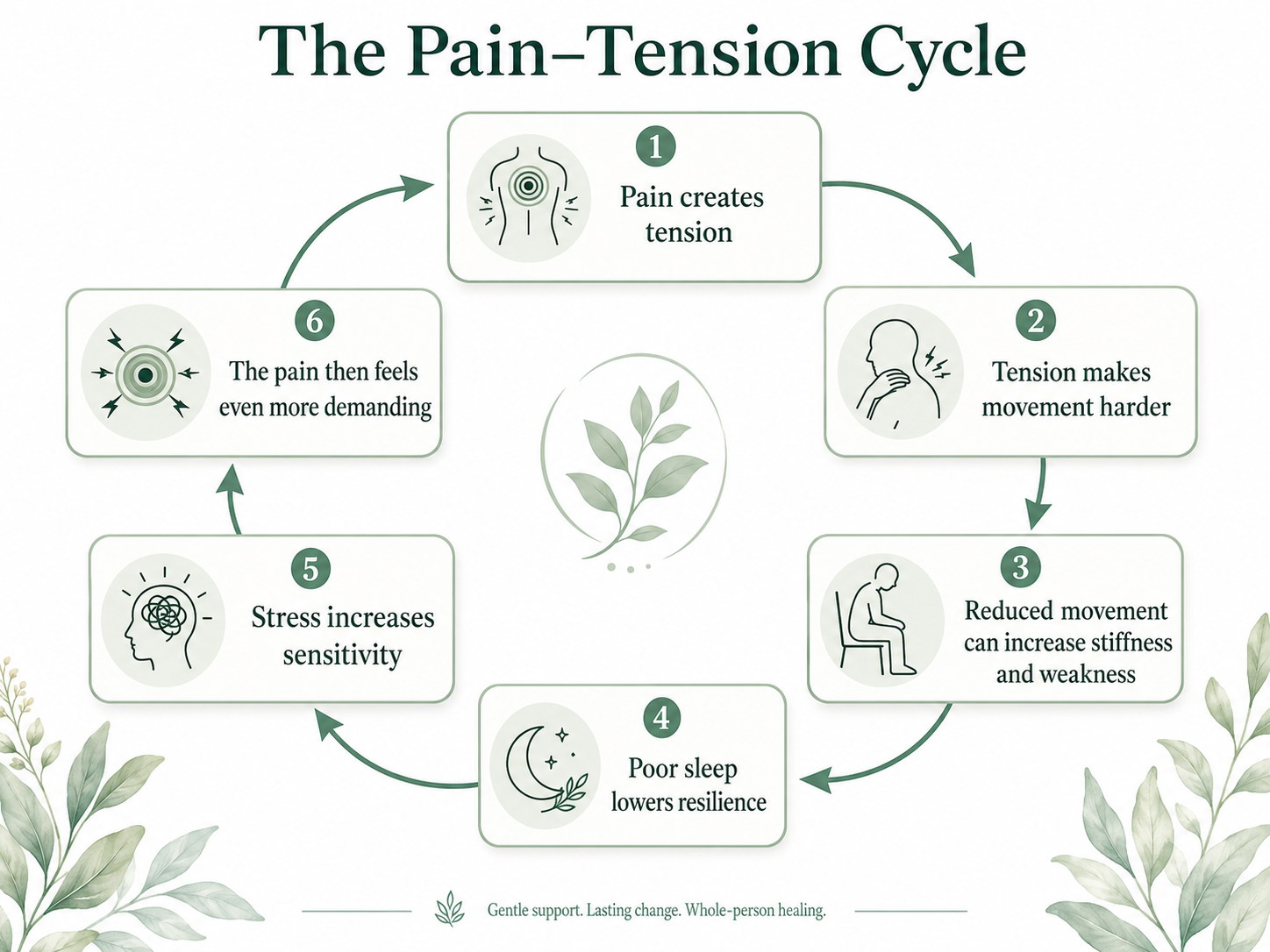
The Pain-Tension Cycle
Stress may not have caused the original hip problem, but it can add another layer once pain has become persistent. This is why simply being told to stretch, rest or “try to relax” may not be enough. The original source of the pain still needs to be understood, while the wider effects on movement, sleep and the nervous system also need attention.
Pain and Sleep Can Reinforce Each Other
Hip pain can make it difficult to find a comfortable sleeping position.
You may wake when you roll over or notice the pain more once the distractions of the day have disappeared. The next day, insufficient sleep can leave you more tired, emotionally reactive and sensitive to discomfort.
Research supports a relationship in both directions: pain can interfere with sleep, while poor sleep can increase vulnerability to persistent musculoskeletal pain and make existing pain harder to manage. Sleep is therefore not separate from the hip problem. It may be one of the factors maintaining it.
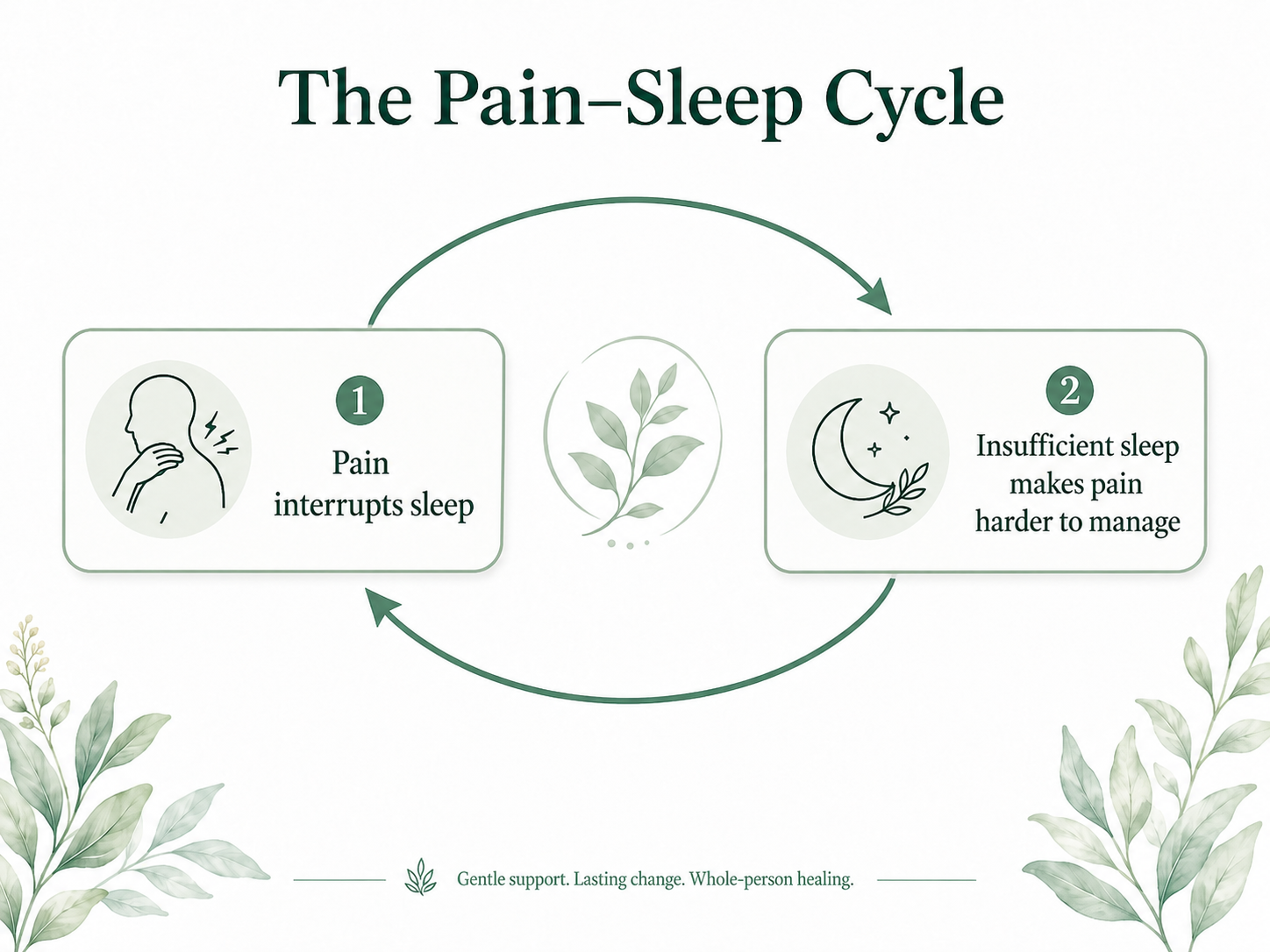
The Pain-Sleep Cycle
Why Hip Pain May Become More Noticeable in Midlife
Many of the women I see report more stiffness, aching or slower physical recovery during their forties, fifties and beyond.
Hormonal changes during perimenopause and menopause may affect joints, muscles, tendons, bones and the way pain is experienced. Musculoskeletal pain is commonly reported during the menopausal transition. At the same time, midlife is rarely quiet. Women may be balancing work, family, caring responsibilities, changing hormones, interrupted sleep and a substantial mental load. There is often little room for recovery, even though the demands placed on the body remain high.
Hip pain during this stage of life should not simply be dismissed as ageing. Hormonal changes may be one part of the picture, but previous injuries, joint health, muscle strength, inflammation, nutrient status, sleep and stress may also be relevant.
What Could Be Contributing to Hip Pain?
Pain around the hip does not always originate from the same place.
It may involve the joint, surrounding muscles, tendons or bursae. Pain may also be referred from the pelvis or lower back, while nerve irritation can cause symptoms that travel into the buttock or leg. Potential contributors include:
Osteoarthritis or changes within the joint
Tendon or bursal irritation
Previous injuries
Muscle weakness or imbalance
Changes in posture, walking or movement patterns
Referred pain from the lower back
Nerve involvement
Inflammatory conditions
Hormonal changes
Poor sleep and inadequate recovery
Nutritional deficiencies
Persistent stress and nervous-system sensitisation
Not every person will have all these factors. The important point is that persistent hip pain should be investigated rather than reduced to one assumption.
What Needs to Be Done?
The first step is to understand where the pain is coming from.
Persistent, worsening or unexplained hip pain may require assessment by a GP, physiotherapist or other appropriately qualified musculoskeletal practitioner. This helps determine whether the main issue lies within the joint, surrounding tissues, lower back, nerves or another area. Once serious conditions and significant injuries have been considered, the wider picture can be assessed. This may include looking at:
The nature and pattern of the pain
Muscle strength and movement
Previous injuries
Sleep quality
Inflammation
Menopausal or hormonal changes
Nutrition and possible nutrient deficiencies
Energy and recovery
Stress and nervous-system load
Existing health conditions and medications
The aim is not to assume that every sore hip needs the same solution. It is to identify which factors are most relevant for the individual and develop a coordinated plan around them.
When Hip Pain Needs Prompt Medical Attention
Seek medical assessment if hip pain is persistent, worsening or limiting your ability to walk, work, sleep or manage normal daily activities.
More urgent assessment is needed when:
Pain follows a significant fall or injury
You suddenly cannot put weight through the leg
The joint is hot, swollen or red
You have a fever or feel acutely unwell
There is new or increasing weakness or numbness
You develop changes in bladder or bowel control
There is numbness around the groin or saddle area
Naturopathic care should complement - not replace - appropriate investigation of significant or ongoing pain.

Looking Beyond the Sore Hip
Persistent hip pain can be complex. Sometimes there is a clear structural or mechanical cause. At other times, muscle tension, poor sleep, inflammation, hormonal changes, nutrient status, stress and a sensitised nervous system may all be contributing to how the pain is experienced.
As a registered naturopath, medical herbalist and nutritionist, I can help you explore these wider influences. I look at your symptoms within the context of your health history, nutrition, sleep, hormonal stage, lifestyle and overall physical and emotional load. From there, we can identify which areas need support and develop a practical, individual plan.
Naturopathic care does not replace medical assessment or physiotherapy when these are needed. It can, however, help connect the pieces that are often considered separately.
If ongoing hip pain is affecting your movement, sleep, energy or emotional wellbeing, you do not have to keep trying to work it all out alone.
Book a naturopathic consultation with me at Balsam Natural Health in Christchurch, and let’s look beyond the sore hip to understand what may be keeping your whole system on high alert.
References:
Nijs J, George SZ, Clauw DJ, Fernández-de-Las-Peñas C, Kosek E, Ickmans K, Fernández-Carnero J, Polli A, Kapreli E, Huysmans E, Cuesta-Vargas AI, Mani R, Lundberg M, Leysen L, Rice D, Sterling M, Curatolo M. Central sensitisation in chronic pain conditions: latest discoveries and their potential for precision medicine. Lancet Rheumatol. 2021 May;3(5):e383-e392. doi: 10.1016/S2665-9913(21)00032-1. Epub 2021 Mar 30. PMID: 38279393.
Runge N, Ahmed I, Saueressig T, Perea J, Labie C, Mairesse O, Nijs J, Malfliet A, Verschueren S, Van Assche D, de Vlam K, Van Waeyenberg T, Van Haute J, De Baets L. The bidirectional relationship between sleep problems and chronic musculoskeletal pain: a systematic review with meta-analysis. Pain. 2024 Nov 1;165(11):2455-2467. doi: 10.1097/j.pain.0000000000003279. Epub 2024 May 28. PMID: 38809241.
Wright VJ, Schwartzman JD, Itinoche R, Wittstein J. The musculoskeletal syndrome of menopause. Climacteric. 2024 Oct;27(5):466-472. doi: 10.1080/13697137.2024.2380363. Epub 2024 Jul 30. PMID: 39077777.